


Generate test data
On the Import / Export tab of any type. Makes more documents that look like the ones already there — for filling a dev database, giving a query plan something to chew on, or reproducing “it gets slow past 100k”.
Analyze
Section titled “Analyze”Analyze reads a sample of the type’s documents and works out how to make more.
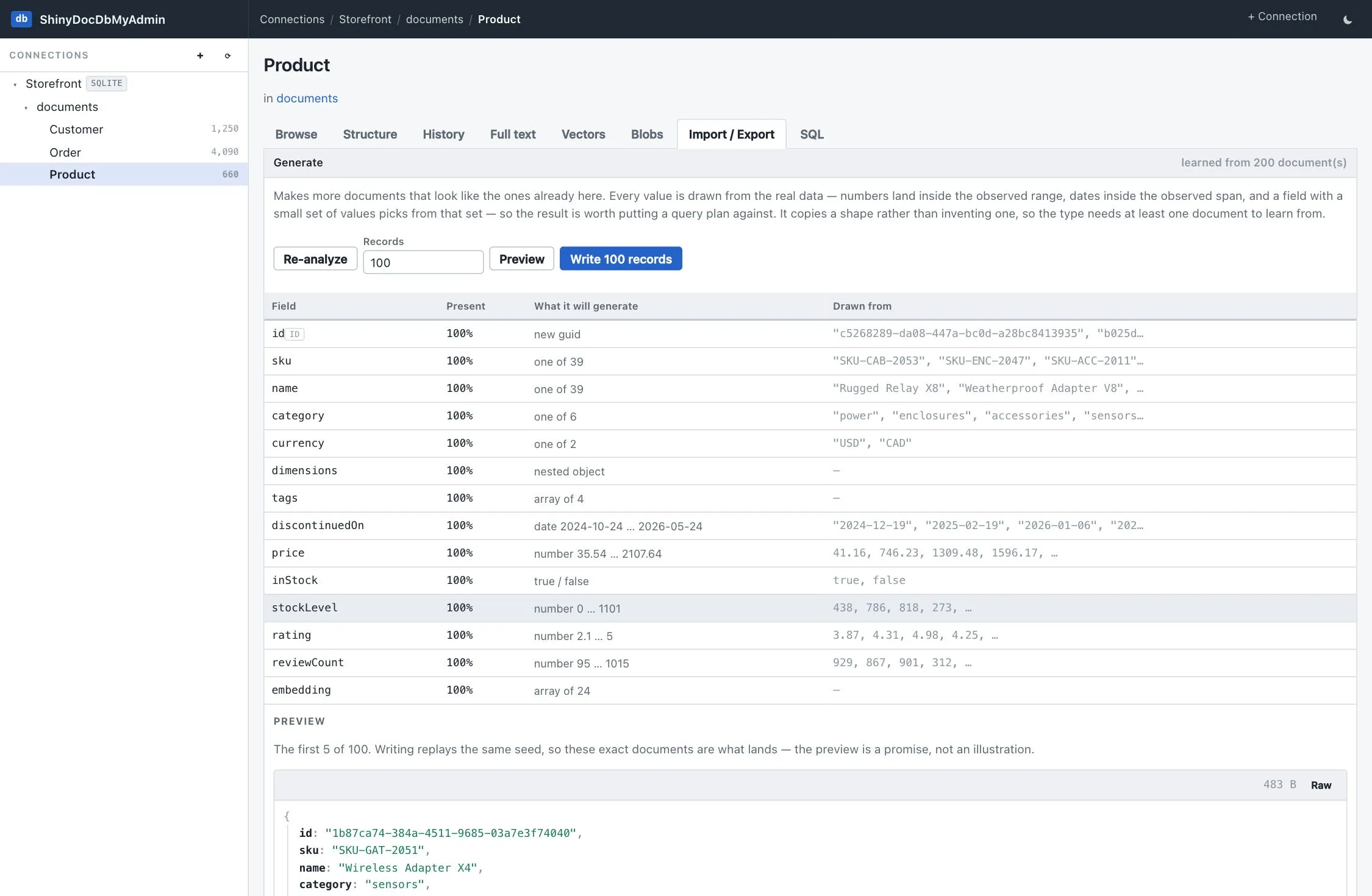
It reports what it inferred per field, with the values it will draw from, so the inference is inspectable rather than magic:
| It sees | It infers |
|---|---|
| a number | the range the observed values occupy |
| a date or timestamp | the span they cover |
| a small set of repeated strings | a categorical field, and picks from that set |
| a field missing from some documents | how often it is actually present, and matches that rate |
| a nested object | the same analysis, one level down |
| an array | its observed length distribution and element shape |
| the id | always replaced — see below |
An array that is the same length in every sampled document is treated as a tuple and profiled per
position, because its slots are not interchangeable — the two halves of a GeoJSON coordinates pair, an
RGB triplet, a min/max range. Variable-length arrays are ordinary collections and generate from one merged
shape, as do fixed arrays longer than eight elements.
Every value comes from the real data
Section titled “Every value comes from the real data”That is the point. Data generated from a schema alone has plausible types and implausible values,
which is no use for judging a query plan or reading a grid: "string1" in a city column tells you nothing
about how your shipTo.city filter will behave, and a uniformly random total tells you nothing about
how a range query will select.
Ids are the exception — they are always replaced, because two documents cannot share one. If the
existing ids follow a scheme (art-0001 … art-0400) generation continues it at art-0401 rather than
mixing GUIDs in beside them.
Preview, then write
Section titled “Preview, then write”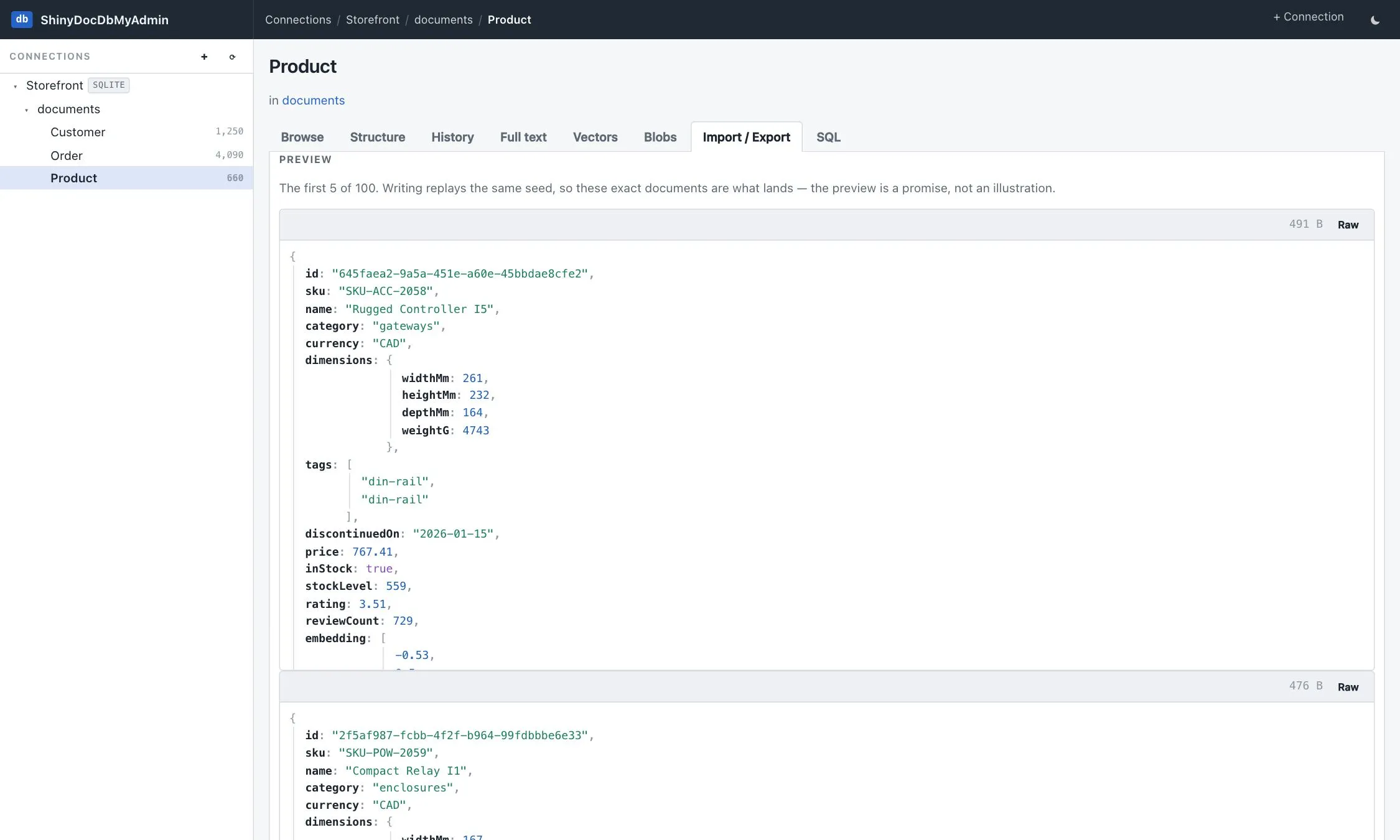
Preview shows the first few records and Write commits them. The two are the same documents: the preview’s seed is replayed on commit, so it is a promise rather than an illustration. Preview again and you get a different draw, from a fresh seed.
Two things to know
Section titled “Two things to know”Bulk generation writes through the schema-free lane — one transaction for the whole batch instead of one per document — and that lane maintains no sidecars. Generated rows are therefore absent from a type’s temporal history, vector index and spatial index. The tool says which of those apply to the type you generated into, and links to the Vectors tab’s rebuild.
Full text is not affected: those indexes are engine-maintained, so generated rows are searchable immediately.
Free text is sampled, not invented. A field with more distinct values than are worth tracking is drawn from the observed values, so long strings repeat. That is the honest limit of generating without a model — and it is still better for a query plan than lorem ipsum.
Where it isn’t offered
Section titled “Where it isn’t offered”Generate needs at least one document to learn from, so an empty type has nothing to copy. It also writes, so it is absent on a read-only connection and in demo mode.