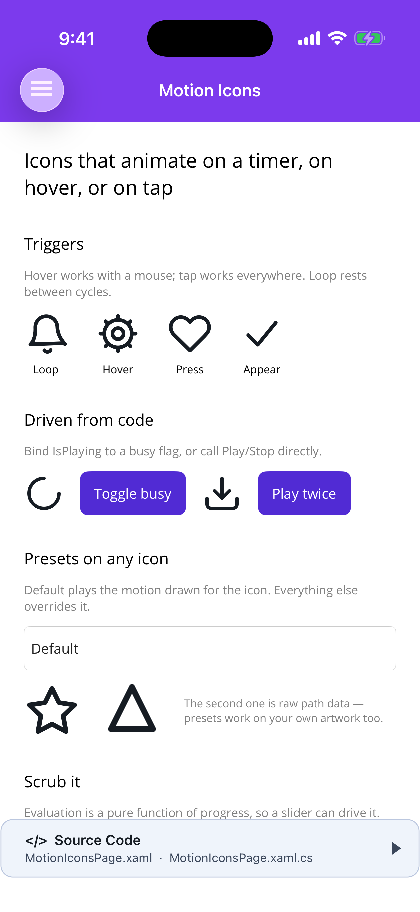
Every built-in icon carries motion authored for that icon specifically. That is the difference between a motion icon and an icon with an animation applied to it: a trash can’s lid lifts off its hinge, a download arrow falls out of the tray and reappears above it, a signal meter lights from the handset outwards.
Names are one flat, case-insensitive namespace — the groups below only exist to make the list readable, and nothing in the API is grouped.
Icon
Motion
add-userThe badge spins a quarter turn as it pops. A plus is symmetric every 90°, so it lands on itself.
attachThe clip swings and lifts, hinged at the top of its own loop.
checkDraws itself on, with a small settle at the end so it lands rather than stops.
closeRotates a half turn — which lands the cross back on itself — while both strokes wipe off and back on.
copyThe front sheet slides off the back one and returns.
downloadThe arrow falls out of the tray, vanishes, and reappears above it.
editThe pencil writes while the line draws itself in underneath.
filterSettles vertically, like something poured through it.
linkThe two halves pull apart while the bar between them wipes out, then snap back together.
loaderTurns while its arc trims, so the ring appears to chase its own tail.
logoutThe arrow leaves through the door, vanishes, and comes back in behind it.
menuMorphs into a cross and back. Each bar spins about its own centre, then slides to the middle.
moreThree dots bounce in sequence.
pinThe head rocks while the needle draws itself down.
plusA quarter turn with an overshoot. A plus is symmetric every 90°, so it can afford to.
powerThe stem draws, then the arc closes around it, then the whole thing pulses.
printThe sheet grows out of the machine edge-first while the one being fed in nudges down.
redoThe head runs forward along the arc as it draws.
refreshOne full turn.
saveThe whole body presses in and springs back; the label nudges down with it.
searchSweeps the glass across the surface it is searching.
sendFlies off the top right and returns from the bottom left while invisible.
settingsThe cog twists and returns. It is not rotationally symmetric, so it cannot stop part way round.
shareThe links draw outwards and each node pops as the link reaches it.
sortThe rows redraw longest-first while the arrow bounces.
trashThe lid swings up off its left hinge while the bin shivers.
undoThe head backs up along the arc as it draws.
uploadThe arrow leaves the tray, vanishes, and reappears below it.
zoom-inThe glass swells while the plus pops.
zoom-outThe glass shrinks while the minus stretches.
Every arrow travels the way it points and pulls its shaft in behind the head; every chevron bounces once in its own direction. Swapping arrow-right for arrow-left in a right-to-left layout therefore gets the mirrored motion for free.
Icon
Motion
arrow-leftTravels left while its shaft retracts behind the head.
arrow-rightTravels right while its shaft retracts behind the head.
arrow-upTravels up while its shaft retracts behind the head.
arrow-downTravels down while its shaft retracts behind the head.
chevron-upBobs upward, landing with a bounce.
chevron-downBobs downward, landing with a bounce.
chevron-leftBobs left, landing with a bounce.
chevron-rightBobs right, landing with a bounce.
expandThe four corner brackets push outward and settle.
collapseThe same four pull inward.
external-linkThe arrow leaves the frame on its own diagonal and returns while the frame recoils.
compassThe needle settles the way a real one does — a wide first swing, then progressively smaller ones.
Icon
Motion
batteryThe charge trims on from the terminal. Trimmed rather than scaled, so the bar keeps its weight as it fills.
bellSwings from its crown, with the clapper running a wider arc so it catches up late.
bookmarkLifts and drops back with a bounce.
calendarThe hangers wobble while the body squashes.
cameraThe lens snaps shut and open while the body recoils.
cartRolls in from the left; the basket keeps going for a moment after the wheels stop.
clockBoth hands turn at a believable ratio: a minute for an hour.
cloudDrifts.
coffeeThe steam rises and thins while the cup breathes.
credit-cardFlips through a horizontal scale of zero; the chip fades out at the halfway point, since there is no back to show.
eyeBlinks — lid and pupil squash about the same line, held shut just long enough to read.
flagThe cloth flutters by squashing towards the pole.
giftThe lid lifts off before the bow springs — a present that pops its ribbon while still shut reads as a box wobbling.
heartA double thump on the rhythm of a real heartbeat.
homeThe roof lifts and lands; the door draws itself in.
lightbulbFlickers twice, then comes up and swells.
locationDrops in from above and lands with a bounce.
lockThe shackle pops up, and the body jiggles as it drops back.
mailThe flap folds up about its crease.
messageThree dots bounce in sequence — the typing indicator.
rocketHovers while the flame flickers and the window dims.
shieldThe tick draws itself on inside while the shield presses in and springs back.
starRocks and swells.
sunThe rays turn 45° — which lands them exactly on themselves — while everything pulses.
tagSwings from its eyelet, the way a luggage tag hangs.
userA small nod.
Icon
Motion
playDips and springs back.
pauseThe two bars pulse out of step.
stopPresses in and springs back.
recordThe dot beats while the ring breathes around it.
skip-forwardThe wedge runs into the end stop and the bar takes the hit.
skip-backThe same in reverse.
shuffleBoth routes draw at once but from opposite ends, so the crossing point appears last.
repeatThe loop draws itself round and the heads pop in behind it.
volumeThe waves leave the cone in order.
muteThe cross draws itself on while the cone shrinks away from it.
microphoneThe pickup arc draws itself on while the capsule swells.
headphonesThe two cups pulse in turn under a breathing band.
musicThe stave bobs while each note head swells in turn.
videoThe lens swings on its hinge while the body breathes.
Icon
Motion
folderThe tab lifts off the line it meets the body on.
folder-openThe front panel swings open from its bottom-left corner.
fileThe corner fold draws along its own crease while the sheet lifts.
file-textThe two rules write themselves on in order.
imageThe sun swells while the horizon draws itself in.
clipboardThe clip rocks where it is actually clipped while the lines write on.
bookA page turns — a horizontal squash about the spine, the only honest fake for a fold with no morph channel.
databaseThe rings light bottom-up, the direction a query travels through a stack.
Icon
Motion
moonRocks and swells.
cloud-rainThree drops fall in sequence, each vanishing at the bottom and reappearing at the top.
cloud-snowThree flakes tumble a quarter turn and fade in and out of step.
lightningTwo flashes rather than one — a single fade reads as a pulse, and a strike does not pulse.
windThe three gusts draw themselves in from the left in sequence while the whole icon drifts.
umbrellaRocks in the wind while the canopy takes the gust.
thermometerThe mercury rises, overshoots slightly and settles.
dropletFalls in from above, lands with a bounce and squashes on impact.
Icon
Motion
activityThe trace sweeps end to end. That is the whole icon, which is why it is one part with one channel.
chartThe bars grow out of the baseline in sequence.
signalThe four bars light from the shortest outwards, like a signal being acquired.
wifiThe arcs light from the handset outwards, like a signal being acquired.
bluetoothThe rune draws itself on, then blinks the way a radio does when it has found something.
trending-upThe line draws upward and the head pops in as it arrives.
check-circleThe ring draws round, then the tick draws inside it, then the whole thing pops.
x-circleThe ring and both strokes draw in order, then the icon shakes its head.
helpThe hook rocks while the dot hops under a breathing ring.
infoThe circle pulses while the “i” hops.
warningShakes while the exclamation flashes.
hourglassTurns a half turn — which lands the frame back on itself — while the sand refills.
thumbs-upRocks about its wrist.
foreach ( var name in MotionIconLibrary.Names)
var bell = MotionIconLibrary. Get ( "bell" ); // throws if missing
var maybe = MotionIconLibrary. Find ( "bell" ); // null if missing
Lookup is case-insensitive. MotionIconLibrary.All gives you the definitions themselves, which is how the sample app builds its gallery.
Register replaces a built-in as well as adding a new one, so an app with its own visual language can swap the artwork for check once at startup instead of passing a definition in at every call site:
MotionIconLibrary. Register ( new MotionIconDefinition (
[ new MotionIconPart ( "mark" , "M5 13L10 18L19 6" )],
MotionSpecBuilder. Build ( 400 , m => m
. Trim ( "mark" , k => k. At ( 0d , 0d , MotionEase.CubicOut). At ( 1d , 1d )))));
Every Icon="check" in the app picks it up.