


Simulator

shiny-bridge-sim is a terminal app that stands in for the native app. It serves every bridge the library ships, but each
one answers with values you choose: a Wi-Fi network that drops mid-sync, a permission the user denied, a BLE device
that appears three seconds late, a GPS walk around the block. Nothing has to be deployed to a phone, and the setup can be
saved as a file and replayed in CI.
dotnet tool install -g Shiny.AppDeviceBridge.Simulator
# your page's dev server — dotnet watch, Vite — served on the simulator's originshiny-bridge-sim --dev-server http://localhost:5288
# or a built appshiny-bridge-sim --app ./bin/Release/net10.0/publish/wwwroot
Open the printed address (http://127.0.0.1:5299/ by default) in a browser. The page and the bridges share that origin,
so a page built with Shiny.AppDeviceBridge.Blazor or the TypeScript client finds the bridges on its own. The page needs
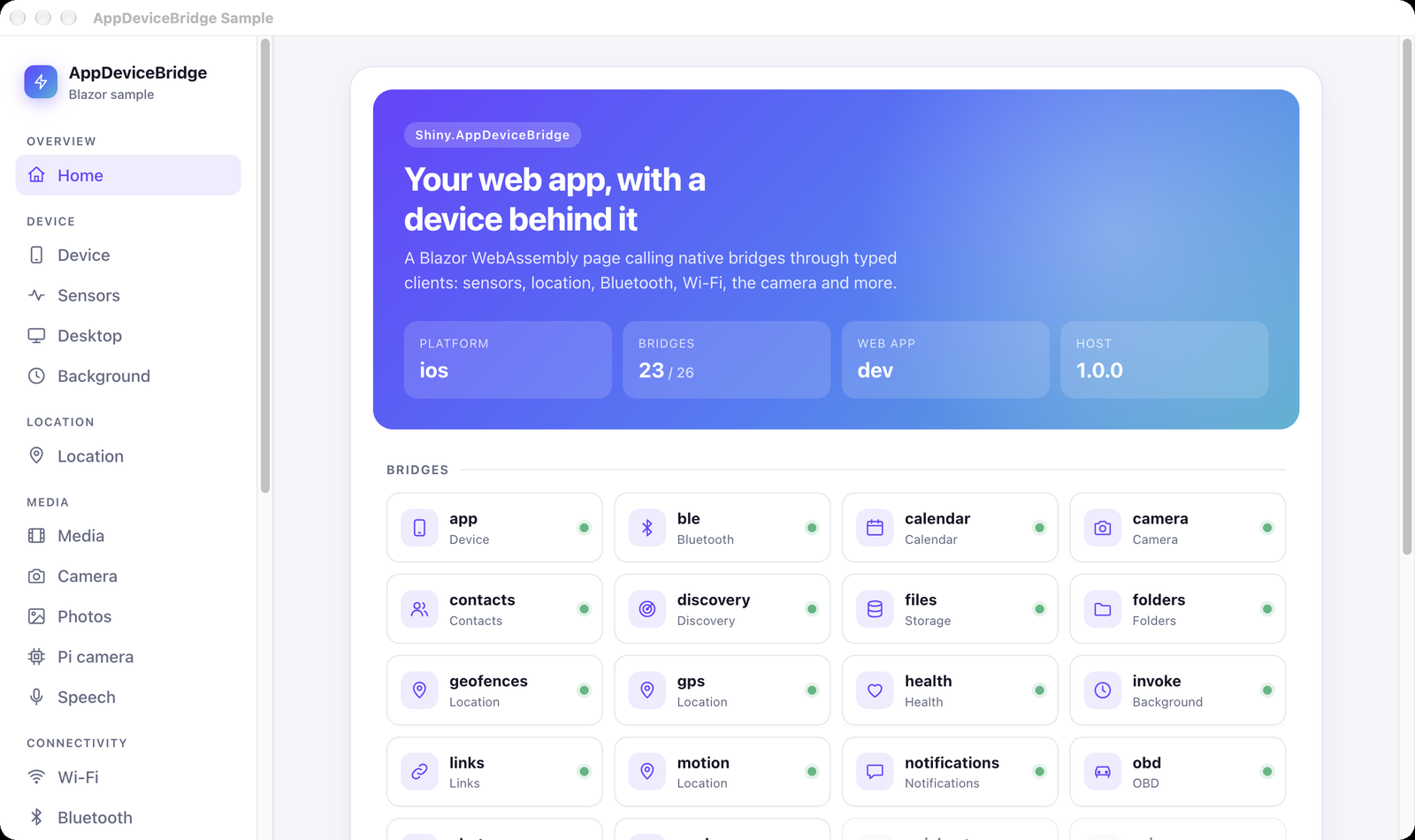
no changes. Here the repository’s Blazor sample runs in Chrome on a Mac, and reports iOS with 23 of 26 bridges because
the simulator says so:
How it works
Section titled “How it works”The simulator runs the real bridge server on Shiny.Net.HttpServer: the same guard, the same AppDeviceBridgePolicies.Bridges
policy, the same event stream, and the real host, settings and files bridges. Every device bridge is replaced by a
simulated one, built from its [BridgeClient] interface, which is the same declaration the C# and TypeScript clients are
generated from. So the simulator answers exactly the routes, query parameters and bodies those clients send, and a new
bridge appears in it as soon as its interface is added to the catalog.
Every route starts out answering with a sample of its contract, generated from the bridge’s source-generated JSON metadata. Property names, casing and enum spelling are exactly what the page’s client reads. A value you set is checked against the contract before it’s used, so the simulator never sends something the real bridge couldn’t.
Security is unchanged from an app’s release build. The server listens on loopback only and admits callers on this machine.
The terminal UI
Section titled “The terminal UI”| Tab | What it’s for |
|---|---|
| Bridges | A tree of the host, every bridge, its routes and its events. Pick a route to set its answer, an event to fire it, a bridge to switch it off. |
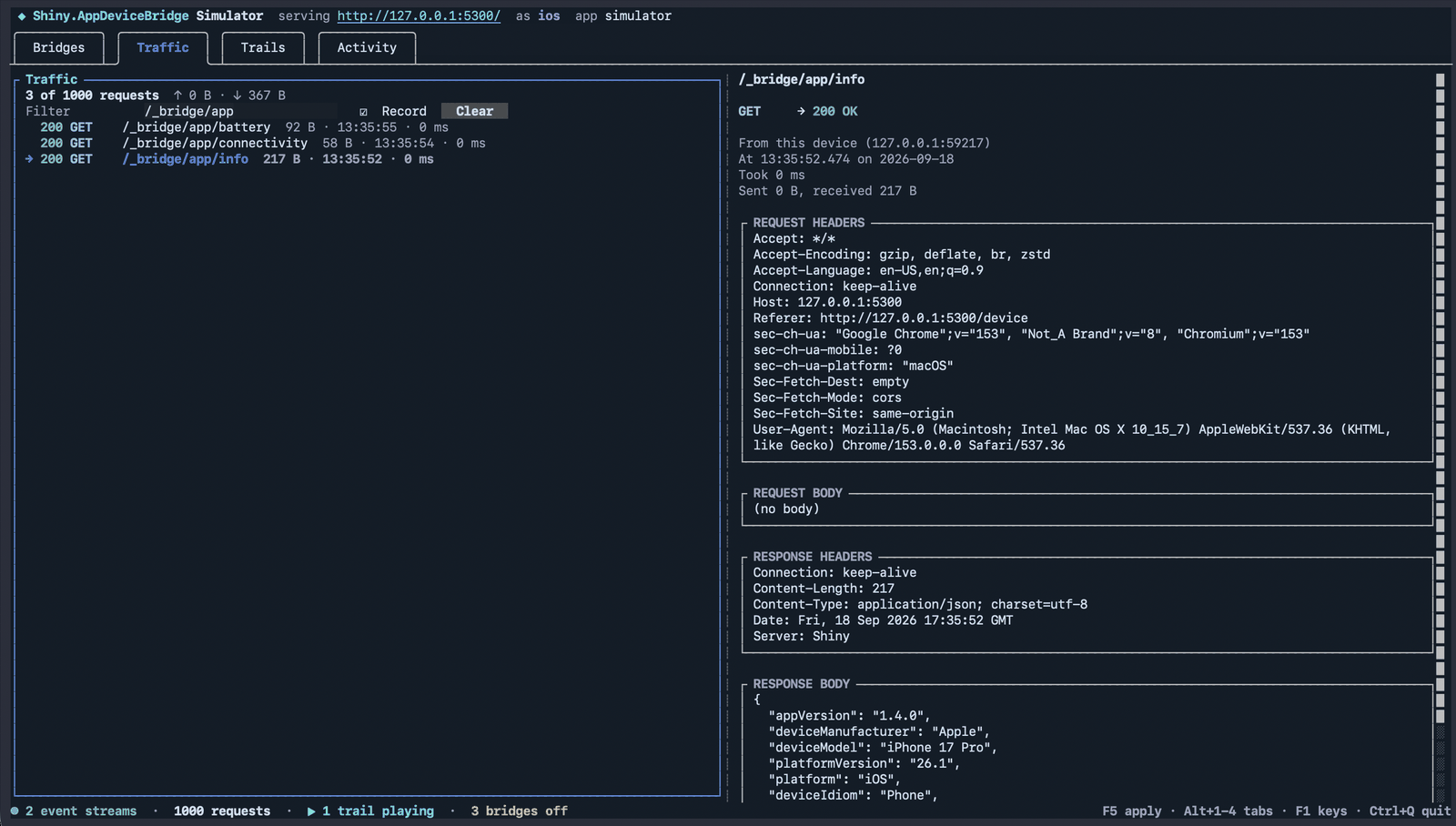
| Traffic | Every request the page made and what it got back, with a filter, a record switch and the full headers and bodies. The same recorder as the MAUI traffic monitor. |
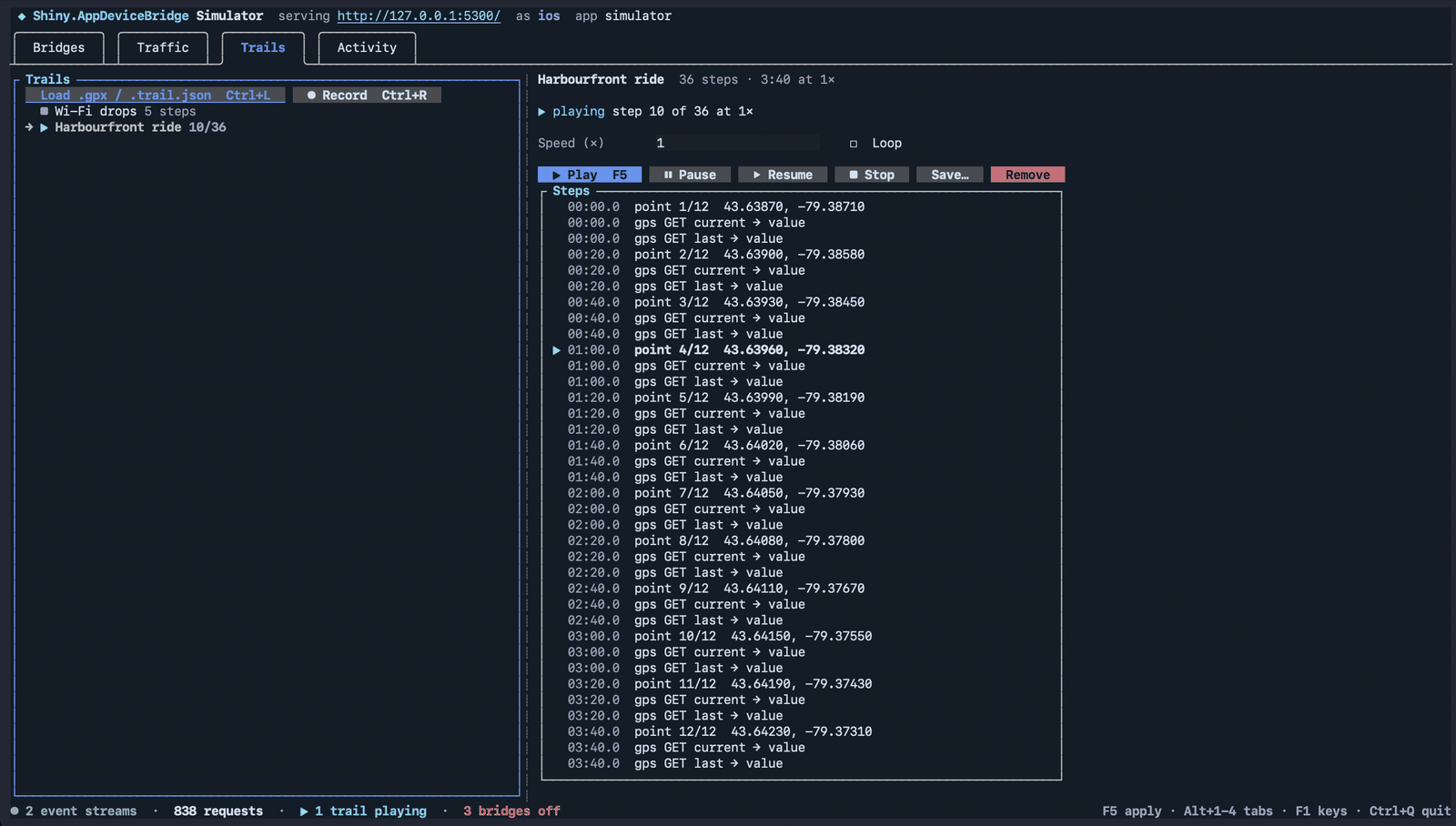
| Trails | Timed scripts: load a .gpx walk or a .trail.json, record one, play several at once, change the speed, loop. |
| Activity | What happened: values changed, events fired, trail steps played. |
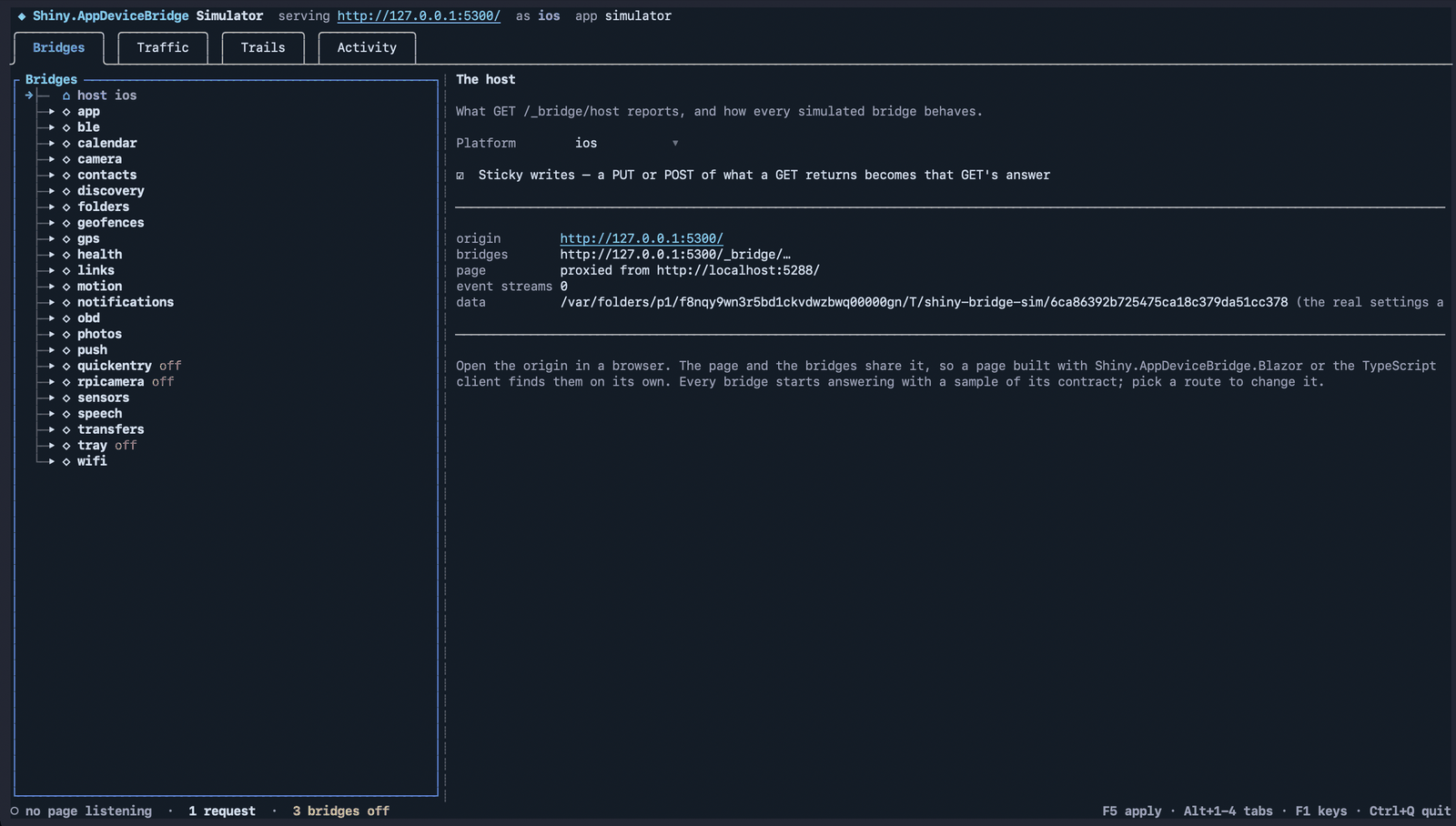
A route can answer with:
- Value (200): the JSON you give, or a file for a route that returns bytes (a photo, a camera snapshot). With no file, a small placeholder image is sent.
- Null (204): what the page’s client reads as
null, such as no current Wi-Fi network. - Error: any 4xx or 5xx with the bridge’s error body. The presets are
501 not_supported,403 access_denied,400 bad_request,404 not_found,409 conflictand500 bridge_failed. The page sees aBridgeExceptionwith that status andCode.
| The route in the simulator | What the page gets |
|---|---|
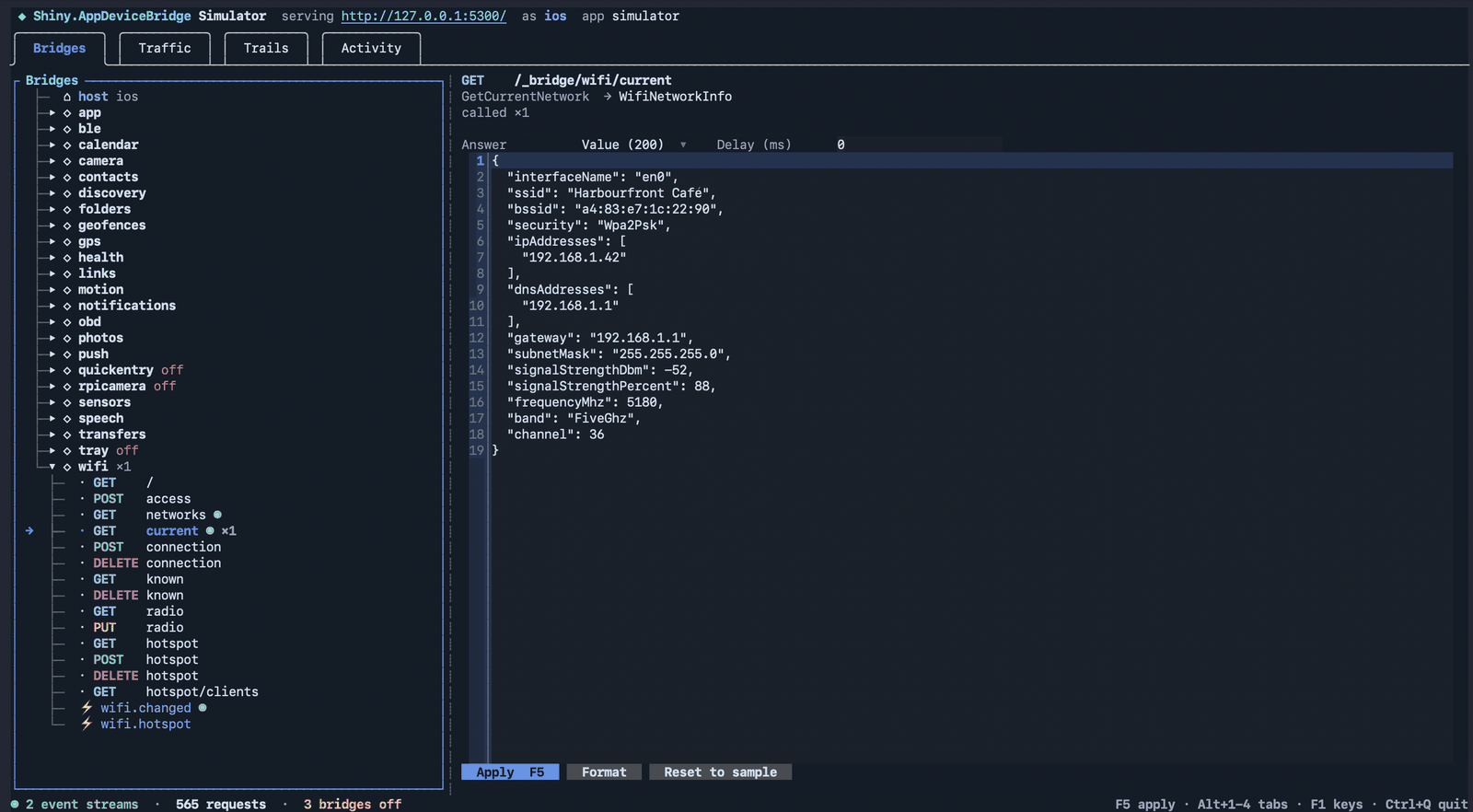 |
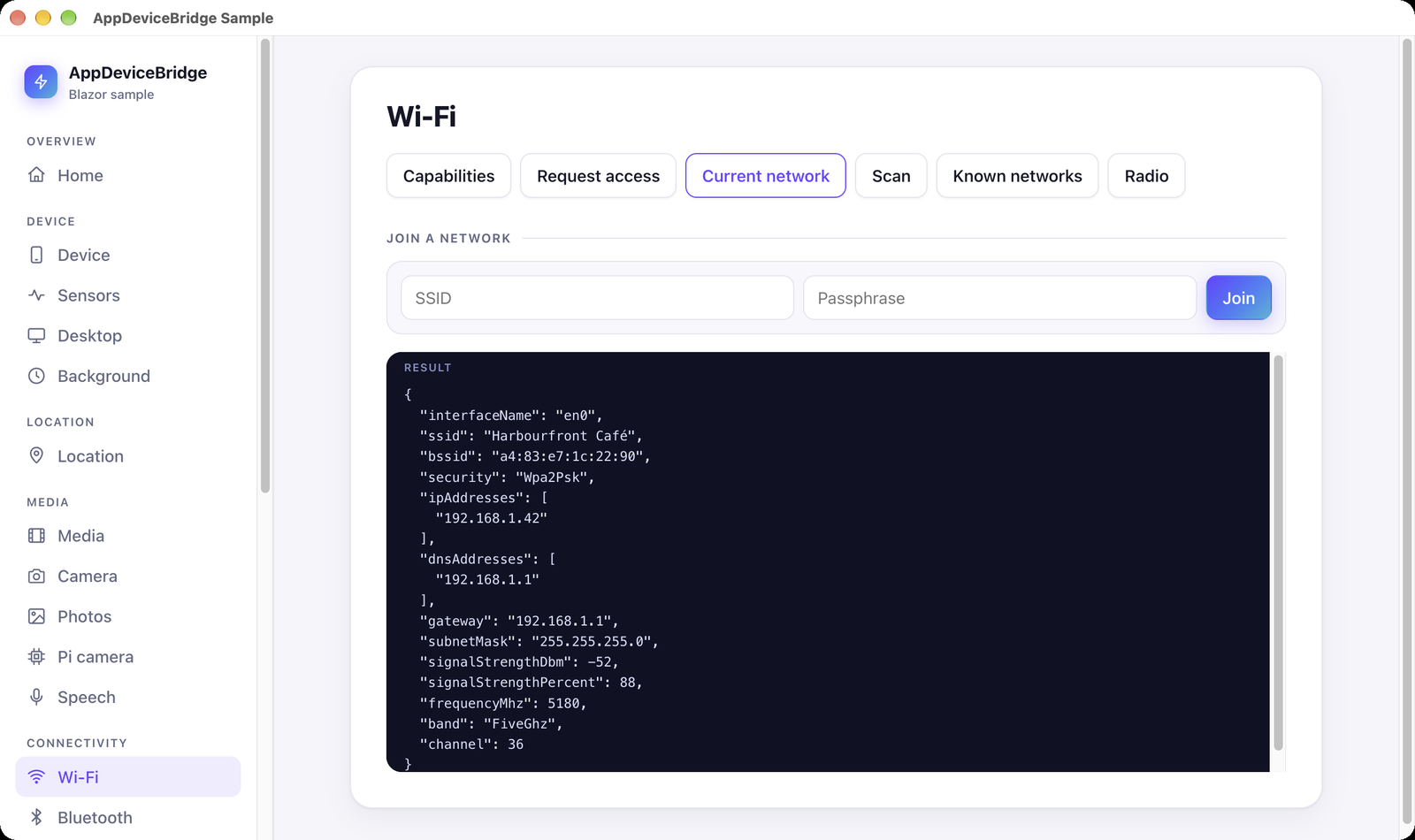 |
Each route can also wait before it answers, to show the page’s loading state or trip its timeout. Switching a whole bridge
off makes every route answer 501 and GET /_bridge/host report it as unsupported, which is the bridge on a platform
without it. The host node sets the platform the page is told it’s on.
Sticky writes (on by default): a PUT or POST whose body is the contract its GET returns, such as PUT wifi/radio or
POST gps/listener, becomes that GET’s answer, so the page reads back what it wrote.
The Traffic tab, filtered to one bridge, with a request picked:
| Key | |
|---|---|
| Enter / Esc | into the selected editor / back to the tree |
| F5 | apply a route, fire an event, play or stop a trail |
| Alt+1 … Alt+4 | switch tabs |
| Ctrl+L | load a trail |
| Ctrl+R | start or stop recording a trail |
| Ctrl+S / Ctrl+O | save / apply a scenario |
| F1 / Ctrl+Q | help / quit |
Placeholders
Section titled “Placeholders”A value or payload may hold placeholders, filled in each time it is sent, so saved values stay current:
| Placeholder | Sent as |
|---|---|
"$now" |
the current time, ISO 8601 |
"$now-5m", "$now+30s", "$now+2h", "$now-1d" |
the current time, offset |
"$uuid" |
a new GUID |
Only a whole string value is a placeholder; "at $now" is sent as written.
Trails
Section titled “Trails”A trail is a list of steps, each after a delay from the one before: fire an event, set what a route answers, or switch a bridge on or off.
{ "name": "Lose Wi-Fi", "steps": [ { "delayMs": 0, "event": "wifi.changed", "payload": { "current": null } }, { "delayMs": 0, "bridge": "wifi", "route": "GET current", "mode": "null" }, { "delayMs": 5000, "bridge": "wifi", "route": "POST connection", "mode": "error", "status": 409, "code": "conflict" }, { "delayMs": 2000, "bridge": "ble", "supported": false } ]}A .gpx file (a track, a route or waypoints) loads as a GPS walk at its recorded pace, or one point a second when it has
no times. Each point is fired as gps.reading, with heading and speed worked out from the points around it, and also
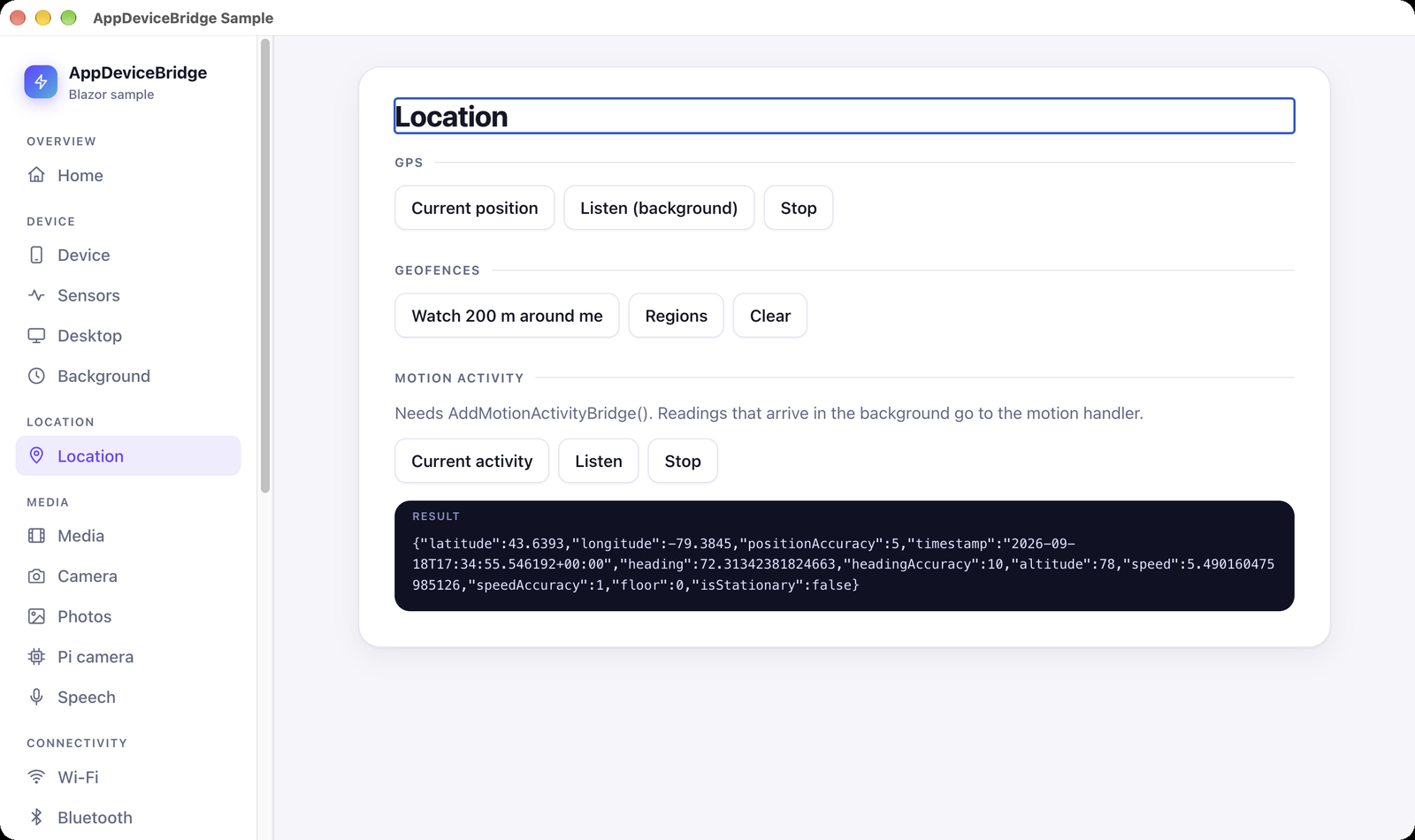
becomes what GET gps/current and GET gps/last answer, so a page that polls sees the same walk as one that listens.
| Playing a GPX ride | The page receiving it |
|---|---|
 |
 |
Recording (Ctrl+R) turns what you do in the Bridges tab into a trail with the time between each step. Save it with Save… and it replays the same way every time.
Scenarios and CI
Section titled “Scenarios and CI”Ctrl+S saves a scenario: the platform, every bridge switched off, every route and event payload that differs from its sample, and every trail. Start with it again, or run without the TUI in a test pipeline:
shiny-bridge-sim --scenario offline.scenario.json --trail walk.gpx --play walk --speed 4 --headless--headless serves, applies, plays and writes the activity and every request to the console until Ctrl+C.
| Option | |
|---|---|
--app <dir> |
serve a built web app: a published Blazor wwwroot, or any folder with index.html |
--dev-server <url> |
serve a dev server’s pages on the bridges’ origin |
--port <n> |
loopback port, 5299 by default, 0 for any free one |
--platform <name> |
android, ios, maccatalyst, macos, windows or linux |
--app-id <id> |
the app id GET /_bridge/host reports |
--scenario <file> |
apply a scenario on start |
--trail <file> |
load a .gpx or .trail.json; repeatable |
--play <name> |
play a loaded trail on start; repeatable |
--speed <n> |
playback speed for --play |
--data <dir> |
where the real settings and files bridges keep data; a temporary folder by default |
--headless |
no TUI |
The sample
Section titled “The sample”The repository’s Blazor sample runs against the simulator unchanged:
dotnet run --project samples/Sample.Blazor --launch-profile browser # http://localhost:5288shiny-bridge-sim --dev-server http://localhost:5288 \ --scenario samples/simulator/sample.scenario.json --trail samples/simulator/harbourfront.gpx